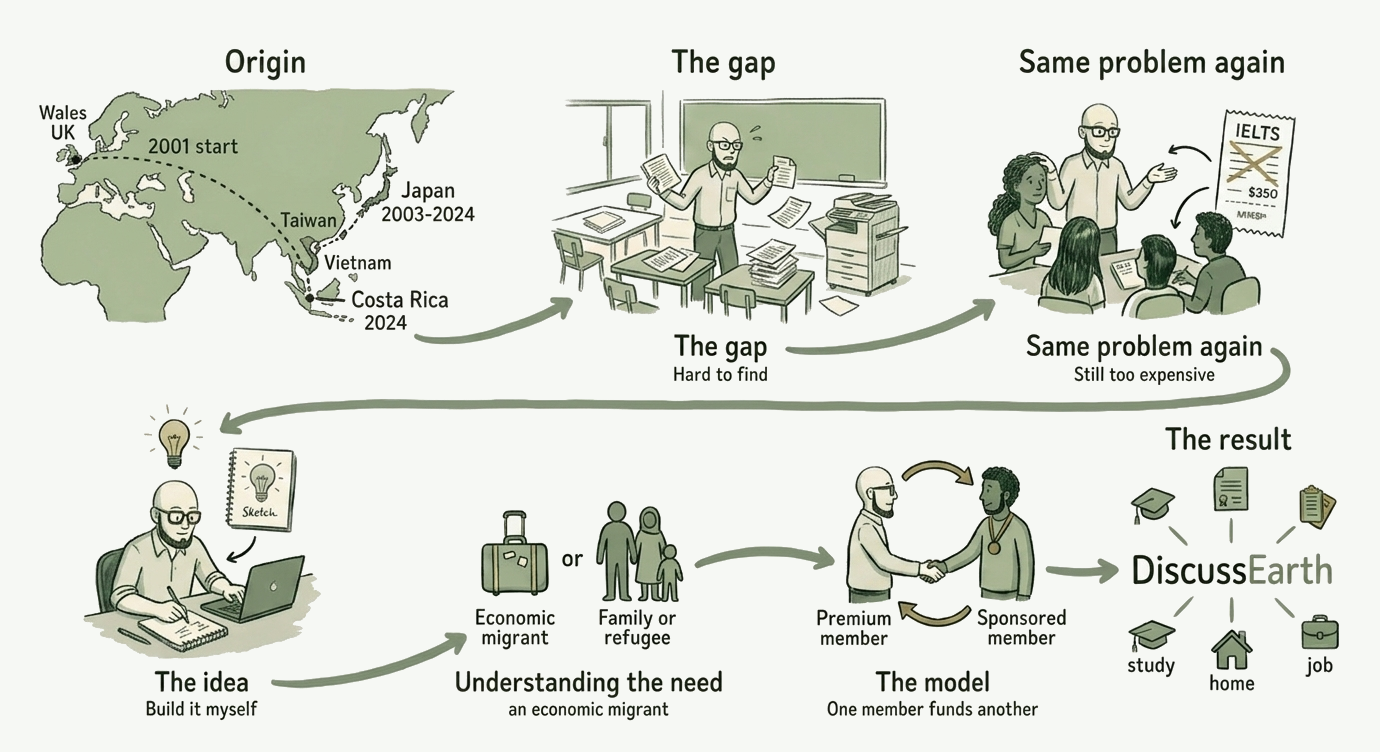
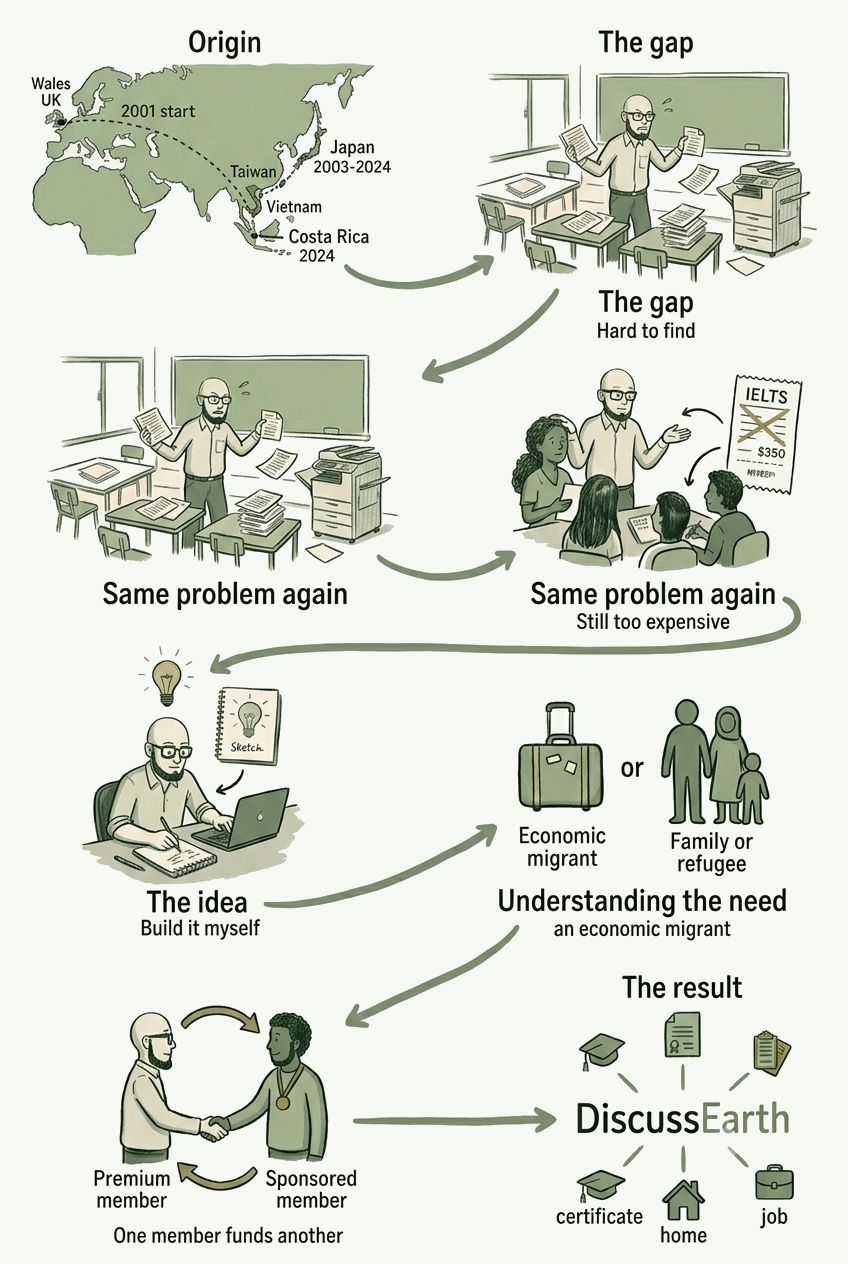
DiscussEarth ("we", "us", "our") provides IELTS and TOEFL exam preparation, and operates on a 1-for-1 model: every paid subscription funds a free account for a displaced learner. This policy explains what information we collect from people who use discussearth.com (the "Service"), why we collect it, and what rights you have over it.
1. Information we collect
Account information. When you sign up, we collect your email address and password (handled by our authentication provider, Supabase — we never see or store your password in plain text). You may optionally add a display name and study-goal information to your profile.
Test and progress data. We store the tests you take, your answers, scores, band/level results, and study streaks so we can show you progress over time. For Writing and Speaking tasks, this includes the text you write or the speech you submit, since that content is what our AI grading is scored against.
Community content. If you post in the Community forum, your display name and post/reply content are visible to other subscribers.
Payment information. Subscriptions are processed by Stripe. We do not receive or store your card number — Stripe handles that directly and shares with us only what's needed to manage your subscription (e.g. plan type, renewal date).
Communications. If you contact us through the Contact page, we receive whatever you submit (name, email, message) in order to reply to you.
2. How we use this information
We use your information to: provide and improve the Service; grade and give feedback on your Writing and Speaking submissions; track your progress and award XP/streaks; manage your subscription and billing; respond to support requests; and maintain the security of the platform.
3. Service providers we use
We rely on a small number of third-party providers to run DiscussEarth, and share only the data each one needs to do its job:
- Supabase — account authentication and our database (profiles, test progress, community posts).
- Stripe — payment processing and subscription management.
- Cloudflare Workers — routes your Writing and Speaking submissions to Anthropic's Claude AI for grading, and proxies other API calls.
- ElevenLabs — generates the spoken audio used in Listening and Speaking tests.
- Microsoft Azure (Pronunciation Assessment) — scores pronunciation in Speaking tasks by analyzing short audio clips of your speech.
- EmailJS — delivers messages submitted through our Contact form.
Each of these providers processes data on our behalf under their own privacy and security terms; we don't sell your information to anyone, and we don't share it with advertisers.
4. Data retention
We keep your account and progress data for as long as your account is active, so your test history stays available to you. If you delete your account, we delete your personal data within a reasonable period, except where we're required to keep records (e.g. payment records for tax/accounting purposes).
5. Your rights
You can review and update your profile information at any time from your Account page. You can request a copy of your data, ask us to correct it, or ask us to delete your account and associated data, by contacting us at team@discussearth.com.
6. Children's privacy
DiscussEarth is intended for learners preparing for university-level English exams and is not directed at children. We do not knowingly collect personal information from children under 13.
7. Security
We use industry-standard practices — including row-level security policies in our database and encrypted connections — to protect your data. No online service can guarantee absolute security, but we take reasonable steps to safeguard your information.
8. Changes to this policy
We may update this policy as the Service evolves. If we make material changes, we'll update the "Last updated" date above and, where appropriate, notify you directly.
9. Contact us
Questions about this policy or your data can be sent to team@discussearth.com.